
Bees and Wasps in Singapore
About bees and wasps in Singapore and what to do when you encounter them
Last updated 31 October 2025
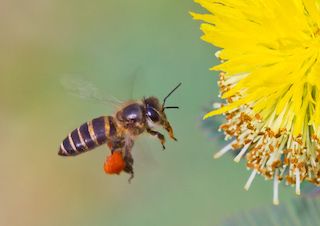
What are bees and wasps?
Bees and wasps are flying insects from the order Hymenoptera. They are important pollinators for a wide variety of plants in Singapore. Wasps are also predators for other insects, and help to control pest populations.
Singapore supports remarkable bee and wasp diversity with over 130 bee species documented.
Distribution & Habitat
Honey Bees
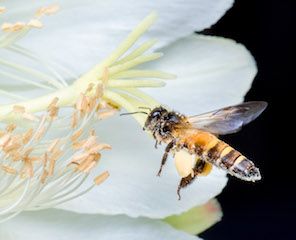
Giant Honey Bee (Apis dorsata)
Singapore has four honey bee species from the genus Apis: Asian Honey Bee, Giant Honey Bee, Black Dwarf Honey Bee, and Red Dwarf Honey Bee.
The Asian Honey Bee, Singapore's most common bee species, thrives in urban environments including rooftop gardens and parks, constructing hives in sheltered spaces such as tree holes, upturned pots, and building eaves.
Giant Honey Bees prefer forests and densely planted parks but occasionally venture into urban areas, typically building single large combs underneath sloping branches of tall trees.
The smaller dwarf honey bee species are common in parks and gardens and nest on a single comb in vegetation.
Stingless Bees
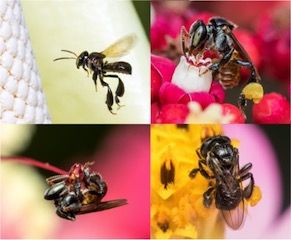
Like honey bees, stingless bees live in large colonies. However, they do not possess stings and are harmless to people. Stingless bees nest within tree crevices, rocky walls, and manmade structures like lamp posts.
Solitary Bees
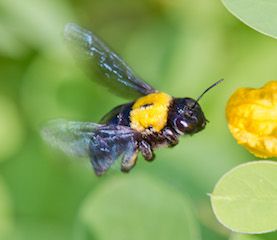
Large Carpenter Bees (Xylocopa spp.)
The solitary bee community encompasses over 100 species displaying diverse colours, shapes, and sizes, including Leaf-cutter Bees, Digger Bees, Large Carpenter Bees, and Pearly-banded Bees. They do not form colonies and inhabit diverse nesting sites including dead wood, twigs, and soil.
Wasps
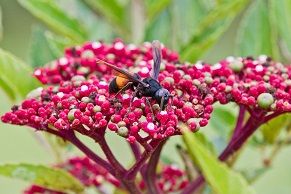
Lesser-banded Hornet (Vespa affinis)
Wasp diversity includes hornets, with the Lesser-banded Hornet being the most common hornet species, and various paper wasp species such as the Sumatran Paper Wasp. Wasps adapt well to both natural and urban environments, constructing nests on trees, shrubs, ground level, building facades, and manmade structures such as roof eaves and fences.
Behaviour
Honey bees are social insects forming large colonies with complex hive structures consisting of multiple parallel wax combs. They exhibit defensive behaviour when their hives are threatened but remain docile whilst foraging away from nests. Giant Honey Bees display unique nocturnal foraging patterns, actively seeking food after dusk and showing attraction to artificial light sources. Dwarf honey bees demonstrate nomadic tendencies, frequently abandoning hives to establish new nesting sites within three to six months.
Stingless bees occasionally engage in swarming behaviour, forming mating clouds outside nest entrances that last several hours.
Solitary bees live independently or in small groups rather than colonies, displaying peaceful and docile temperaments even when nests are disturbed.
Hornets and paper wasps exhibit aggressive defensive behaviour when protecting their colonies, readily stinging perceived threats to their nests.
Important Ecological Role(s)
Bees and wasps serve crucial ecological functions as pollinators of plants and predators of other invertebrates.
Stingless bees, despite their tiny size, play particularly important roles as pollinators of forest trees. Honey bees contribute significantly to plant reproduction through their foraging activities at flowers. The diverse community of over 130 bee species in Singapore collectively supports plant biodiversity through pollination services.
Wasps complement this ecosystem service by controlling invertebrate populations through predation, helping maintain ecological balance.
What should I do when I encounter a bee or wasp hive in a park?
Keep your distance and back away.
Do not approach, provoke, or touch the hive.
Leave it alone, especially if it is in its natural habitat. Bees and wasps can become aggressive and attack, especially when provoked or if they see you as a threat to the hive.
Call NParks’ Helpline at 1800-471-7300.
What should I do if I have been stung by a bee or wasp?
If you have been stung by a honey bee, a stinger will be left behind in the wound. There would be no stinger to remove if you have been stung by a wasp.
Scrape the stinger out using the edge of a card. Do not pull out the stinger with your fingers as you may accidentally squeeze and release more venom into your skin.
Wash wound with soap and water and apply an ice pack. Monitor for allergic reactions, e.g. rashes, swelling, breathlessness.
Seek immediate medical attention if allergic reactions occur, or if you have been stung multiple times.
What should I do if I am swarmed by bees or wasps?
Cover your head and move as far as possible from the hive, being careful to avoid tripping.
Run toward shelter as this disorients chasing the attacking insects.
Do not swat at the insects – this will cause them to become more aggressive.
Do not jump into water – agitated bees may continue to attack after you emerge.
What should I do if a bee or wasp lands on me?
Honey bees frequently land on people to drink their sweat.
Refrain from smacking the insect. Injuring it may cause it to sting or release alarm pheromones that would attract more aggressive bees or wasps.
Calmly move the part of your body that the insect is resting on. If it still does not move, gently brush it off and it will fly away peacefully.
Photos by Zestin Soh and Hong Yao Lim