
Macaques in Singapore
About macaques in Singapore and what to do when you encounter them
Last updated 31 October 2025
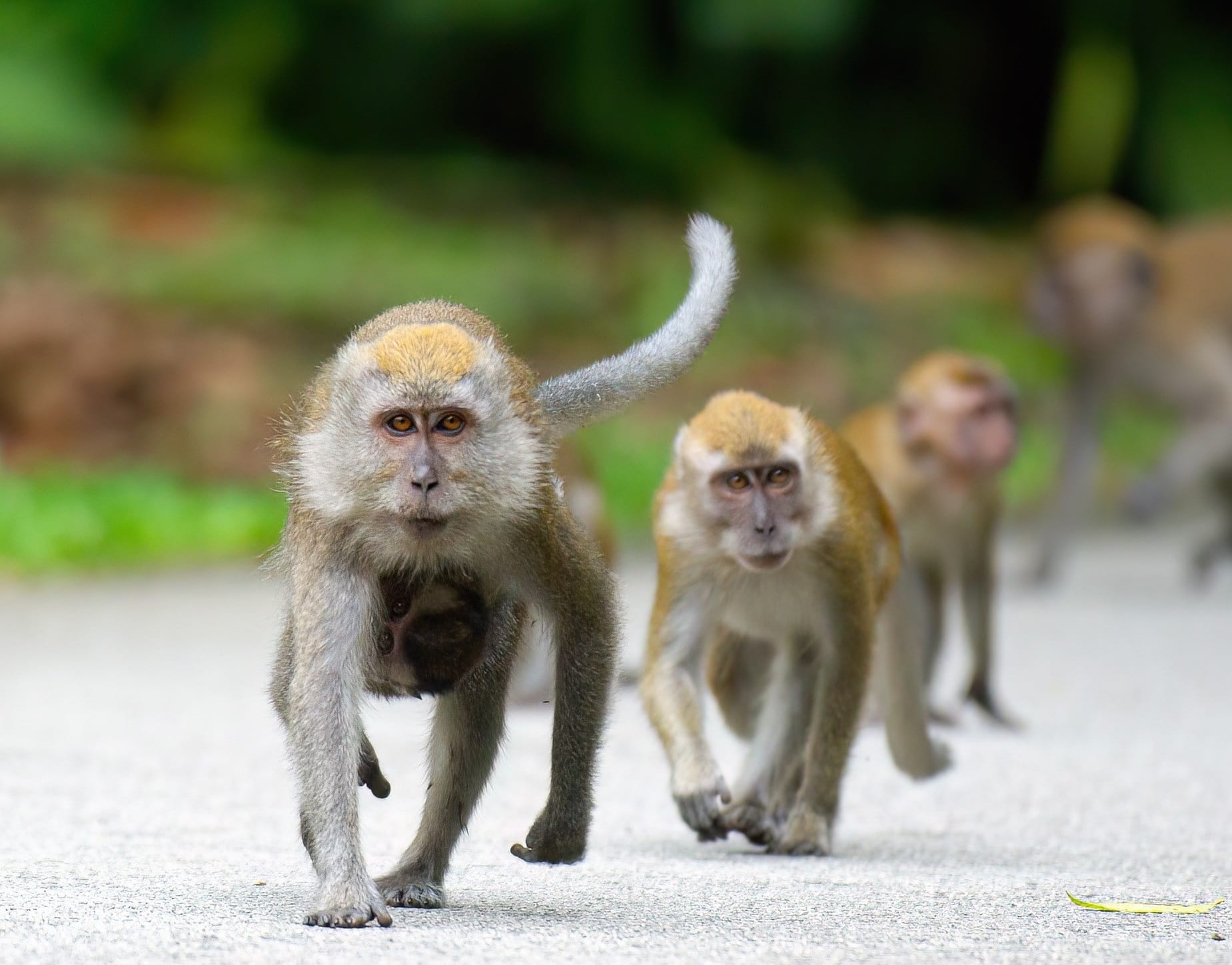
What are macaques?
Macaques refer to monkeys in the genus Macaca and they are a type of primate. The are 23 species of macaques and they can be found throughout Asia, North Africa, and Europe. In Singapore, the most common non-human primate is the Long-tailed Macaque (Macaca fascicularis), also known as Crab-eating Macaque. It is one of our native primate species and is a fundamental part of Singapore’s biodiversity. They are commonly referred to as monkeys.
Distribution & Habitat
It naturally inhabits forested areas and can also be found in mangroves. However, being a forest fringe animal, it also frequents its immediate surroundings to explore and forage for food.
Behaviour
Being generalists, the natural diet of the long-tailed macaque consists of insects, leaves, flowers and fruits. It occasionally eats crabs, hence its other common name, Crab-eating Macaque. However, they can supplement their diet with human food as it is more easily accessible with higher caloric content. It is therefore important to not feed them and properly dispose of any food waste.
Macaques are highly sociable and spend mornings and late afternoons foraging, grooming and socialising with other members of its family. The social hierarchy of this species is complex. The highest-ranking male exhibits significant dominance over the lower-ranking males and has priority when it comes to foraging and grooming. Similarly, the highest-ranking female dominates over the other females, favouring those close to her.
The long-tailed macaque has a variety of facial expressions to communicate in its social environment. Being familiar with these expressions will help to mitigate any potential human-macaque conflict. For example, when it is feeling fearful and anxious, or being submissive towards a more dominant individual, it shows a fear grin with its eyes open and teeth bared. When giving warning to stay away, it bares its teeth with both its eyes and mouth open.
Important Ecological Role(s)
Macaques help in seed dispersal through the consumption of fruits naturally found in the forest. As they move around the forest, they defecate. The nutrients contained in their excrement give the seeds a higher chance of germination and survival.
What should I do when I encounter a macaque?
Remain calm and quiet.
Avoid making direct eye contact with them.
Macaques may view this as a challenging gesture and become provoked.
Back away slowly and do not turn around or run.
Hide or throw away any object like plastic bags you may be holding that is attracting the attention of the macaques.
Having been conditioned to recognise plastic bags and other containers as food sources, they may instinctively grab these items when they see them.
Do not touch, chase, or corner the macaque.
Leave it alone, especially if it is in its natural habitat. Macaques may attack in self-defence. Keep a safe distance away from the animal and observe it from afar.
Do not feed macaques.
When the monkeys get used to being fed, they reduce their natural inclination to forage in the forest and are drawn into human areas, which can be dangerous for them. This will incur negative long-term impacts as they also help in seed dispersal through the consumption of fruits naturally found in the forest. Feeding of all wildlife in Singapore is also prohibited under the Wildlife Act.
What should I do if I am affected by macaques?
Being innately curious, macaques may visit our homes to explore or to seek food.
If a macaque enters your home, remain calm and quiet. Use a stick to hit the ground to discourage the monkey from approaching you and coax them towards the exit. If you require further assistance, call our Animal Response Centre at 1800-476-1600.
How do I prevent macaques from entering my home?
Monkey-proof Your Home
Install window mesh/grilles on windows and doors. This allows for ventilation while preventing monkeys from gaining access to your premises.
Close all windows and doors, including bathroom windows, when monkeys are spotted in the vicinity or when no one is at home. Monkeys tend to stay in an area only for a short period of time if they are unable to find food. Also, most have a regular travelling pattern and timing. It will be helpful to note those timings and ensure that all access points are secured during those periods.
Secure pet entrances to prevent access by monkeys. Small pet entrances to allow cats and dogs to get in and out during the day can be used by monkeys to gain access into your home. Ensure such entrances are latched when not in use.
Keep Food Out of Sight
Without visible food sources, your home is less attractive to monkeys. Store food in ovens, microwaves, cabinets, or covered in opaque containers. Keep prayer offerings within the house.
Use recyclable cloth bags when walking home with groceries. As monkeys recognise plastic grocery bags as food sources, they are likely to try to snatch the bags. Cloth bags and backpacks are less attractive to them.
Manage your Refuse
Double-knot your garbage bag and dispose of it in bins. Secure the lid with an elastic strap or bungee cord. Secured trash bins make it less likely for monkeys to scour for food in your neighbourhood. Double-knotting your garbage bag will prevent spills and make food waste less accessible to monkeys.
Keep your lawn and surrounding areas litter-free. Monkeys are innately curious and drawn to litter, such as food containers and soda cans. By keeping your lawn and the area around your home free of litter, you can discourage the monkeys from coming in.
Harvest Your Fruits
Harvest fruits regularly and/or cover them with an opaque material. In the forest, fruit trees are natural sources of food for the monkeys. If you own a fruit tree, harvest the fruits regularly, or cover them with opaque material like a gunny sack to keep them out of sight from the monkeys.
If you have further queries, please contact us through our online feedback form at https://www.avs.gov.sg/feedback.
Photos by Bryan Lim
Resources: