
Monitor Lizards in Singapore
About monitor lizards in Singapore and what to do when you encounter them
Last updated 31 October 2025
- Max Khoo (banner).JPG)
Malayan water monitor (Varanus salvator)
What are monitor lizards?
Monitor lizards are large reptiles belonging to the genus Varanus. They are characterised by their long bodies, strong limbs, powerful tail and forked tongues.
The most common monitor lizard among the three found in Singapore is the Malayan water monitor (Varanus salvator) that can grow up to 3m long. The other two species, the clouded monitor lizard (Varanus nebulous), and the rarest Dumeril’s monitor (Varanus dumerilii) can grow to a length of 1 to 1.5m.
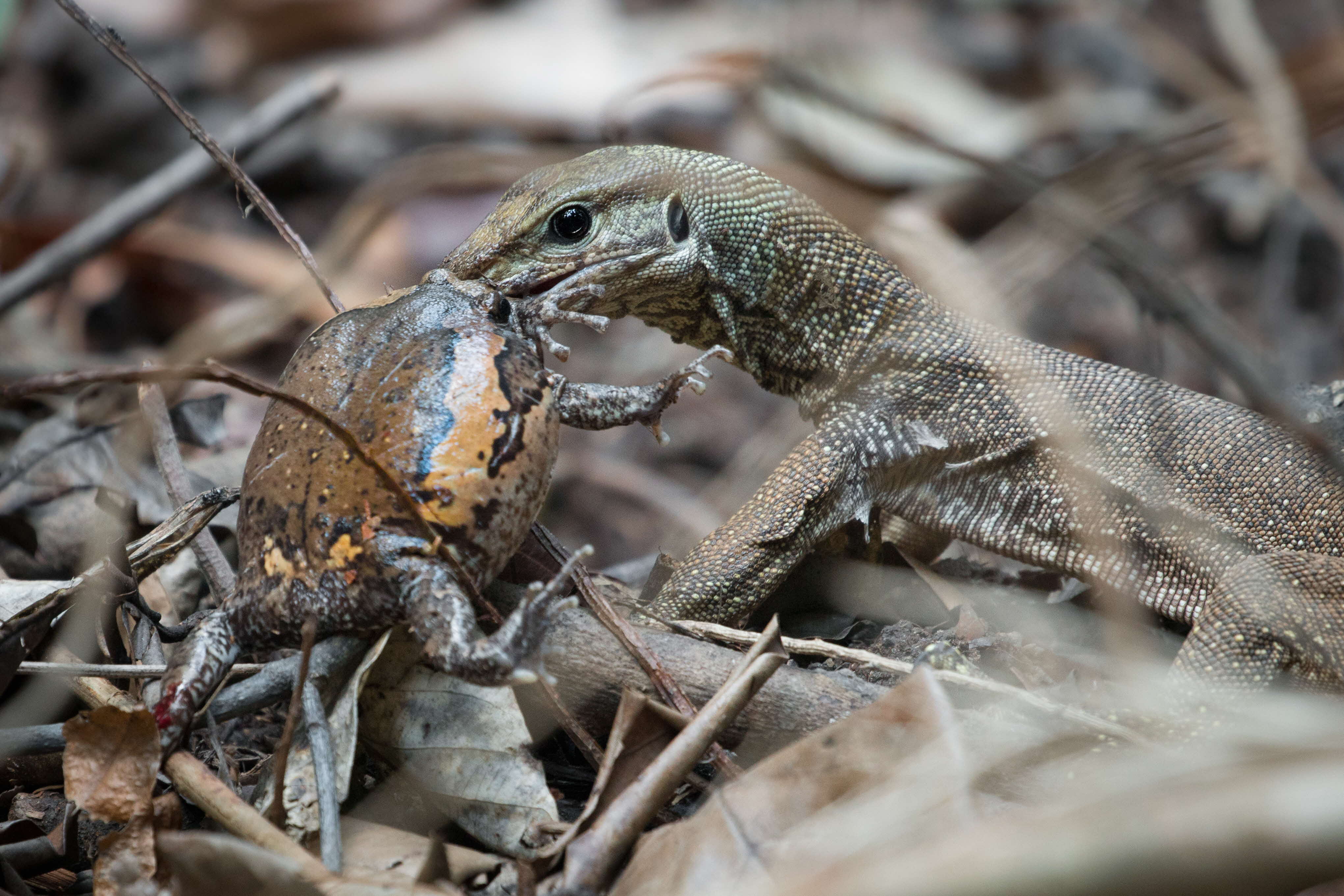
Clouded monitor lizard (Varanus nebulous)
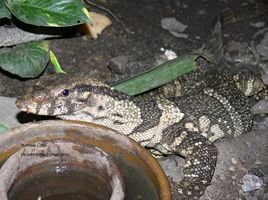
Dumeril’s monitor (Varanus dumerilii)
Distribution & Habitat
Monitor lizards can be found in forests, mangrove swamps, and even man-made canals.
Behaviour
Monitor lizards are mostly carnivorous and feed on insects, crabs, snakes and fish. Some also scavenge on carrion. The carrion meat that gets stuck in the monitor’s teeth are teeming with bacteria that can cause infections in the bite wound. However, the main cause of death of prey is the venom secreted by the monitor.
These lizards possess glands that secrete venom to kill its prey. The venom can cause rapid swelling, drop in blood pressure, and blood clot inhibition. However, it has a relatively mild effect on humans.
Despite appearing intimidating due to their size, monitor lizards are generally shy and would rather stay away from humans. Like most wild animals, they do not attack unless provoked.
Important Ecological Role(s)
Monitor lizards feed on a huge variety of prey. They helpe control the population of their prey, and in turn are a source of food to larger predators like crocodiles. They also play an important role as scavengers, speeding up biomass decomposition and recycling.
Conservation
In Singapore, it is illegal under the Wildlife Act to remove wild animals, including monitor lizards, from the wild. Those found in nature reserves and other areas managed by NParks are also protected by the Parks and Trees Act 2005.
Poaching of monitor lizards exists in Singapore. However, they are often not brought to the attention of local authorities.
What can I do to help?
If you witness any illegal trading or poaching, collect evidence such as photos or videos of the traps, animals, poachers, and/or their vehicle license plate number. Then, call NParks' Animal Response Centre at 1800-476-1600 to provide information to the authorities.
Do not keep monitor lizards as pets, or buy any monitor lizard products, such as meat and skin products. Raise awareness by sharing with your friends and family about the threats to monitor lizards, and what they can do to help.
What should I do when I encounter a monitor lizard?
If you come across monitor lizards that are injured, distressed or trapped, call our Animal Response Centre at 1800-476-1600 and we will send professionals who are trained in handling and caring for wildlife to assist you.
Please avoid handling the lizard yourself as this may cause further stress or injury to the animal. The lizard may also bite in self-defence.
Stay calm and do not be alarmed.
These animals are shy and will not attack humans unless provoked or cornered.
Do not touch, chase or corner the monitor lizard.
Monitor lizards may attack in self-defence. Keep a safe distance away from the animal and observe it from afar.
Do not feed the monitor lizard.
Monitor lizards have their own food in the environment and their natural eating habits keep the ecosystem healthy. Feeding of all wildlife in Singapore is also prohibited under the Wildlife Act.
If you have been bitten by a monitor lizard, seek medical attention immediately.
Though monitor lizards do secrete venom, it is not fatal to humans. The main cause for concern would be a bacterial infection from the bite.
What should I do if I am affected by monitor lizards?
As monitor lizards feed on carrion, they may be attracted to your food waste. Practice proper food waste disposal such as double bagging your garbage bag and disposing of it in bins.
To prevent monitor lizards from entering your home, install wire mesh or acrylic panes at least 1 meter high and seal any holes or gaps on your property. As some monitor species can climb trees, prune trees and overhanging branches to restrict access into your home.
If you have further queries, please contact us through our online feedback form at https://www.avs.gov.sg/feedback.
Photos by Max Khoo and Michael Cota
References:
Ng, P.K.L., Corlett, R.T. & Tan, H.T.W. (ed.) (2011). Singapore Biodiversity: An Encyclopedia of the Natural Environment and Sustainable Development. Singapore: Editions Didier Millet & Raffles Museum of Biodiversity Research. from Singapore Biodiversity Encyclopedia (2011)