
Flora Identification and Analysis
How we identify flora species being traded
Last updated 30 October 2025
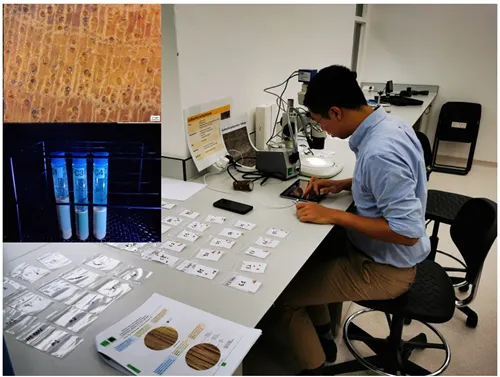
Wood identification process using wood anatomy and other physical methods like extract fluorescence.
The Centre for Wildlife Forensics (CWF) taps on the extensive reference library of plants from the Singapore Botanic Gardens Herbarium, as well as its links with institutions throughout the world to enable the CWF to identify and extract DNA from plants for accurate identification. This is also known as wildlife forensics. This enables us to determine the species being traded and helps to accurately identify possible endangered species that are illegally traded so that enforcement actions can be taken to ensure the long-term conservation of such species.
The Singapore Xylarium – a collection of authenticated timber specimens – will be established to complement the extensive reference library of plants. It comprises a collection of literature on timber identification, timber samples, cross sections of timber samples, and a timber DNA library to facilitate researchers to compare and identify timber specimens through their unique characteristics and genetics. This in-house identification of timber species using a combination of wood morphology, genetics and chemical analysis will enable Singapore to investigate and prosecute the illegal trade in CITES timber more efficiently. We will also be able to share information about the species with international organisations, or the source countries where the illegal timber originates from.
What are the CITES Timber species?
CITES timber species are a subset of the regulated plants, covering only 22 genera and more than 80 species of commercial timber. The rules pertaining to timber species are summarised on the CITES webpage Implementation of the Convention for tree species. The NEPCon publication, A Practical Guide to CITES, is a good introduction to the intricacies of the framework.
Identification of timber
The identification of timber is called for when there is reason to suspect that an endangered CITES species is passed off as a similar looking but non-CITES species. These species may or may not be closely related, and their exact species would be difficult to determine based on general appearances alone. The timber identification process is as follows:
1. Initial identification: Wood Anatomy
Researchers compare the sample of wood to be identified against references like books and paper to confirm the identity of wood shipments.
The sample can also be processed and sectioned to be looked at under a microscope, allowing researchers to identify the timber using the microscopic structure of the wood.
However, this process of using visual clues to identify species is only able to narrow it down to the genus level. It also requires specialised training and experience, together with the usage of published wood anatomy resources in books, papers, and online resources (e.g. The InsideWood database or DELTA).
Recently, there have been attempts to augment and automate vision-based wood identification using computer image analysis by US Fish and Wildlife Services (US FWS). The programme is called the Xylotron.
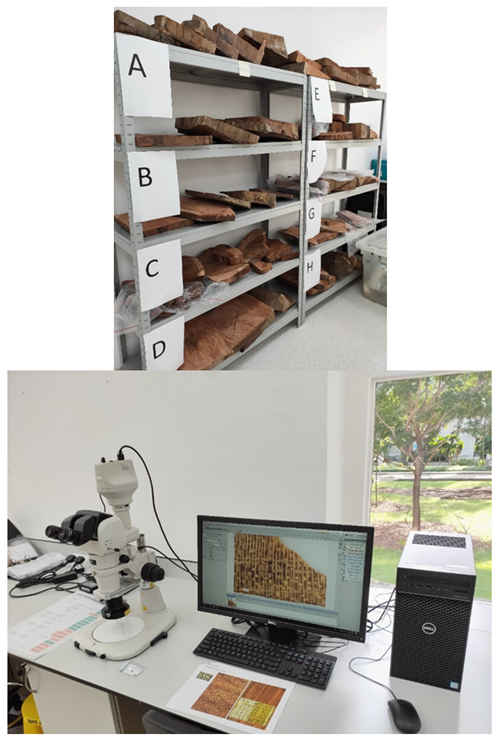
Timber samples are collected and catalogued before being processed and sectioned for identification using microscopic structure of wood.
2. DNA Analysis and Direct Analysis in Real Time Mass Spectrometry (DART-TOFMS)
These two methods allow researchers to differentiate timber samples further into species and specific population of origin.
DART-TOFMS is often the preferred method as processed wood often yield insufficient useful DNA.
Photos by Benjamin Lee and Max Khoo