Bird flu
What you need to know about bird flu
Last updated 19 November 2025
On this page
What is bird flu?
Avian Influenza (AI), commonly known as “bird flu”, is caused by infection with avian influenza Type A viruses. Strains are classified as low pathogenicity avian influenza (LPAI) or high pathogenicity avian influenza (HPAI), depending on their ability to cause disease in poultry (e.g. chickens). LPAI strains cause minimal to no signs of disease in poultry, while HPAI strains can result in severe disease with high mortalities in poultry.
Different subtypes of AI viruses may be identified according to their “H” and “N” subtypes, (e.g. H5N1, H7N9). Influenza viruses have the ability to mutate and adapt particularly fast, which can lead to the emergence of novel strains with new characteristics, e.g. higher severity or different host preference.
Who is at risk of bird flu?
Many species of waterfowl, especially wild geese, ducks and swans, carry the bird flu virus naturally in their intestines and respiratory tract without showing clinical signs. Chickens are very susceptible to bird flu, which can cause them to be very sick and die.
Bird flu in mammals is typically uncommon, as the virus is not well-suited to infecting mammals. Nevertheless, due to various factors, more HPAI cases in mammals have been reported in recent years. Mammals generally cannot spread HPAI to other mammals; instead, they typically become infected due to the consumption of or contact with infected birds or their body fluids (e.g., faeces). As Singapore is currently free of HPAI, cases in mammals are unlikely to occur here.
Cats can contract bird flu and may become severely ill as a result. It is possible for dogs to be infected by bird flu viruses, but very few cases have ever been reported worldwide, suggesting that infections in dogs are very rare.
In rare cases, people can be infected by bird flu. Most historical cases of bird flu in people are linked to direct exposure to infected poultry, e.g. agriculture workers, in countries where bird flu is present in birds. Singapore is HPAI-free, so the risk to human health is very low.
Is bird flu present in Singapore?
To date, there have been no reports of HPAI in Singapore. AVS work with other agencies like the Singapore Food Agency (SFA) to implement pre-border, border and post-border measures to protect against bird flu.
Pre-Border and Border Measures
To guard against the risk of incursion of bird flu, AVS requires countries exporting poultry, poultry products and eggs to Singapore to be free from HPAI. AVS and SFA work closely to ensure that these requirements are met. As part of accreditation, countries are assessed to ensure that the country has control measures in place to ensure that the exported poultry, poultry products and eggs are free of bird flu.
Similarly, ornamental birds are allowed to be imported into Singapore only from sources free of bird flu. The birds are also subject to pre-export quarantine and testing for bird flu to ensure that they are free from bird flu before they are exported to Singapore.
AVS monitors outbreaks of bird flu worldwide and takes measures to suspend sources that have outbreaks of bird flu. In addition, AVS follows up with further checks when the consignments of live birds arrive in Singapore.
Post-Border Measures
Farms and slaughterhouses are also required to ensure that biosecurity measures are in place, and the public is not allowed to visit these establishments. AVS and SFA work closely to ensure that these measures are implemented in the local farms and slaughterhouses. Additionally, AVS regularly inspects pet shops that sell birds to ensure they are free from bird flu.
AVS also conducts regular checks and surveillance on migratory birds as well as common birds such as crows, mynahs and pigeons.
Emergency Preparedness
AVS has a contingency plan to deal with an outbreak of bird flu in Singapore. For example, in the event of an outbreak of HPAI in any of our poultry farms, AVS and SFA will take immediate action to control and eradicate the disease, in line with international practice. All poultry in affected farms will be humanely culled and safely disposed of. Surveillance and monitoring will also be carried out in the other unaffected farms to ensure that they are free from bird flu.
How is bird flu transmitted?
Animals
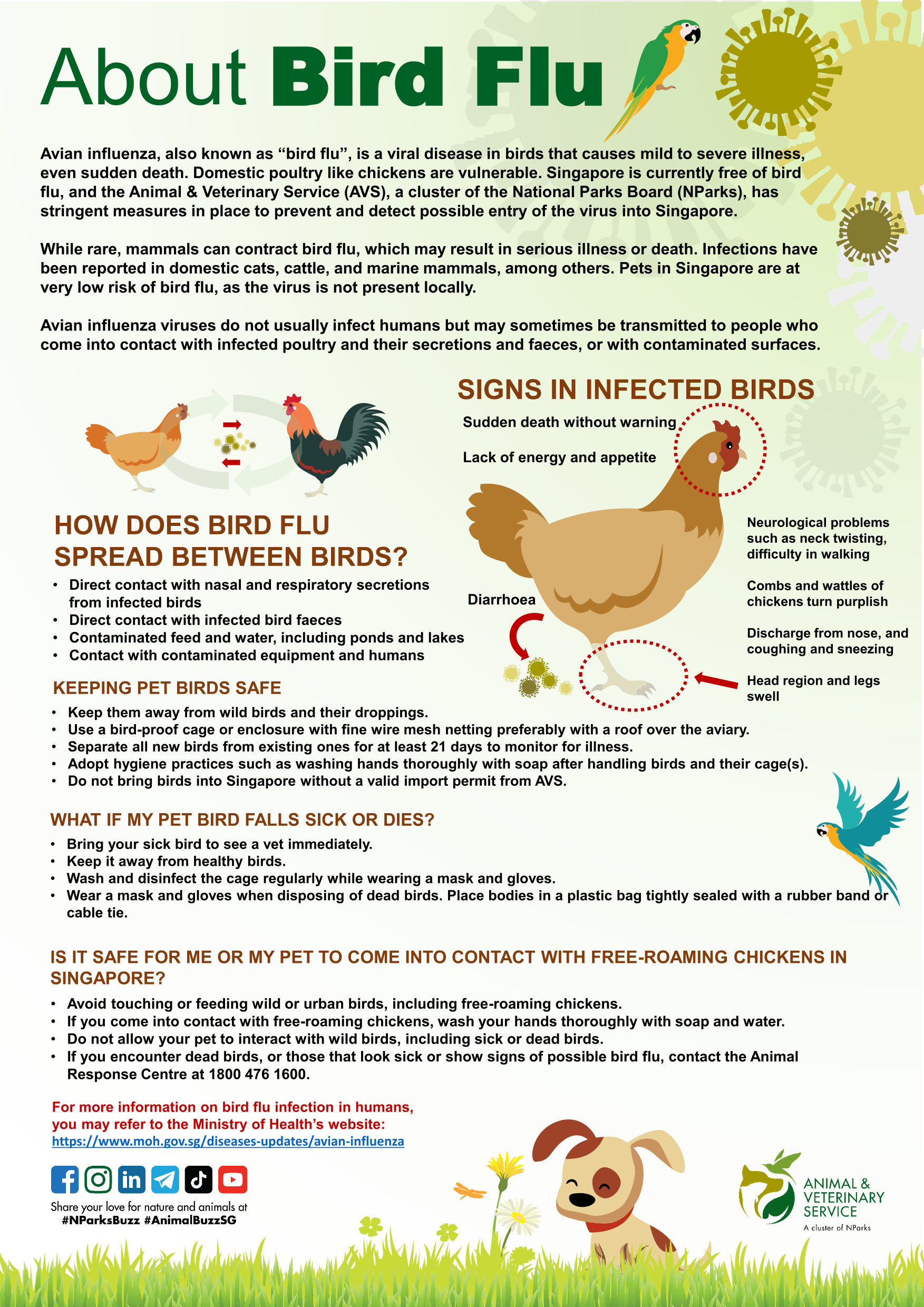
For birds, the virus is highly contagious and can be spread between birds through direct contact; contact with nasal and respiratory secretions or faeces from infected birds; or contact with contaminated equipment, feed and water.
For cats and dogs, most reported bird flu infections occur when there are many cases of bird flu in the local bird population. Cats and dogs typically get infected by feeding on sick or dying birds.
Humans
Bird flu can be transmitted to people through direct or close contact with infected poultry, or surfaces and objects contaminated by secretions or excretions from infected birds.
To date, there is no evidence to suggest that people have been infected with bird flu virus through the consumption of properly cooked poultry or eggs.
To date, there has been no sustained human-to-human transmission reported.
Symptoms of bird flu
Animals
Birds
In poultry such as chickens, HPAI usually causes severe illness. Few birds in infected flocks survive. Infected poultry can show signs such as:
Lack of energy and appetite
Swelling of the head, eyelids, combs, wattles and legs
Purple discolouration of the wattles and combs
Nasal discharge
Coughing and sneezing
Diarrhoea
Neck twisting
Sudden death
In wild birds, there can be a wide variation in clinical signs depending on the strain of bird flu and the species of bird infected. Some wild birds show little or no signs of illness if infected. Others may become very ill and show clinical signs similar to those seen in infected poultry.
Mammals
HPAI infections in mammals have wide variation in clinical signs. Even within the same species, some animals may have only mild illness while others may become very sick. In general, HPAI-infected mammals may show some or all of the following signs:
General: lethargy, loss of appetite, listlessness, fever
Respiratory: difficulty breathing, nasal discharge
Neurological: difficulties in coordination
Gastrointestinal: diarrhoea, vomiting
Humans
Signs and symptoms of bird flu infection in humans are similar to those of regular human flu. They can include:
High fever (usually over 38 degrees Celsius)
Cough
Sore throat
Runny nose
Difficulty breathing
Abdominal pain
Vomiting
Diarrhoea
Complications such as pneumonia, respiratory distress, and death can occur.
Persons who have recently visited countries with bird flu and had close interactions with poultry or wild birds overseas should seek medical advice from a doctor if they develop the above signs and symptoms.
What should I do if I suspect my pet has bird flu?
If your pet bird is sick, bring it to your veterinarian. If you have more than one bird, separate the healthy birds from the sick birds if possible. The birds should be kept in enclosures that are not adjacent to each other. As a general precaution, adopt hygiene practices such as washing hands thoroughly with soap and water after handling the birds and the cage.
When handling dead pet birds, the following steps must be observed:
Put on a mask and a pair of gloves
Place the bodies in a plastic bag tightly sealed with a rubber band or cable tie
Dispose the plastic bag containing the bodies together with your garbage
Disinfect the bird cage and wash your hands thoroughly after disposing of the dead bird
If you have concerns about the health of your cat or dog, please consult your veterinarian.
How can I reduce the risk of bird flu infections?
Cat/Dog Owners
As Singapore is free from HPAI, it is unlikely that pet cats or dogs will be infected by bird flu in Singapore. Nonetheless, as a general precaution, owners should not let their dogs or cats come into contact with wild birds or animals. If owners have any concerns about the health of their cat or dog, please bring them to a veterinarian for medical attention.
Bird Owners
Given Singapore's current bird flu free status, and the various disease prevention measures and conditions already put in place, pet birds and poultry kept in Singapore currently do not pose a risk to the general population. Nonetheless, as a general precaution, anyone who handles pet birds should also practise good hygiene, such as washing hands thoroughly with soap before and after handling their pets. Nonetheless, bird flu can potentially be spread by wild migratory birds.
Owners should ensure that any pet birds are kept within bird-proof cages or enclosures with:
A fine wire mesh netting to prevent contact with any bird, poultry or animal from outside the enclosure, and
A proper roof to prevent any droppings, waste, feathers and other particles from any bird, poultry or animal from entering the bird-proof cage or enclosure.
Also, owners should not introduce birds of unknown origin to their existing pet birds.
Owners should also engage a veterinarian for assistance, should any birds start showing signs of sickness and/or if they have concerns regarding the health of the birds.
No more than 10 poultry (including chickens) are allowed to be kept in any premises. On top of this, owners are also subjected to rules of the managing body of the premises, which may or may not allow the keeping of poultry within their managed areas.
Members of Public
Singapore is currently free from HPAI. In general, wild birds do not present any risk of bird flu to members of public; this includes common urban birds such as free-roaming chickens pigeons, mynahs, sparrows, and crows. AVS also has biosurveillance measures to monitor and test urban birds for disease.
It is safe to visit nature reserves and nature parks even during migratory season, as Singapore is HPAI-free; AVS has biosurveillance measures in place to screen migratory birds for bird flu. Visitors are highly unlikely to catch avian flu from wild birds. As always, please observe birds and animals from a safe distance; do not approach, feed, or touch them.
Nonetheless, as a precaution, members of the public should not touch or feed wild birds and animals, including free-roaming chickens. In the event that you come into contact with wild birds or animals, you should practise good hygiene habits and wash your hands thoroughly with soap and water.
If you find dead birds in public areas, you can contact the National Environment Agency at 1800-225-5632 for assistance to remove the carcasses. If you find dead birds in HDB estates, you may contact the respective Town Council managing the estate to remove the carcasses. As a precaution, members of the public should avoid touching any dead birds or animals.
Other FAQs
1. Bird flu is usually spread by migratory birds. Is it safe to go to Sungei Buloh Wetland Reserve or other parks and reservoirs?
Singapore is free from bird flu. It is safe to visit Sungei Buloh Wetland Reserve and other parks and reservoirs, as it is unlikely that visitors would catch avian flu from wild birds.
Human infections have mostly occurred after close contact with infected poultry. In addition, there is an on-going surveillance programme for bird flu in wild birds at Sungei Buloh Wetlands Reserve where swabs are collected regularly from wild birds for testing.
For the safety of wildlife and of yourself, please be reminded not to touch or handle any wild birds.
2. Will crows and other common birds in Singapore such as pigeons and mynahs pose a health risk to us?
AVS regularly screens crows, mynahs and pigeons for the bird flu virus. So far, no bird flu has been detected. Some birds, such as pigeons, have been shown to be less susceptible to being infected with the bird flu virus. Please be reminded not to touch or handle any wild birds – this would include crows, pigeons, mynahs, free-ranging chickens and other common birds.
Further reading
https://www.cda.gov.sg/public/diseases/avian-influenza