Licensing of cats
Licensing requirements, fees, and process
Last updated 16 December 2025
On this page
All pet cats must be licensed. This is for traceability in the event of an outbreak in disease.
You can apply for a new cat licence online via the Pet Animal Licensing System (PALS) at pals.avs.gov.sg from 1 September 2024. Please note the information below before submitting your application.
For step-by-step guides on licensing your cat on PALS, please refer to this page.
Licensing requirements
Licence applicants and licensees are required to comply with the following requirements:
Before licence application
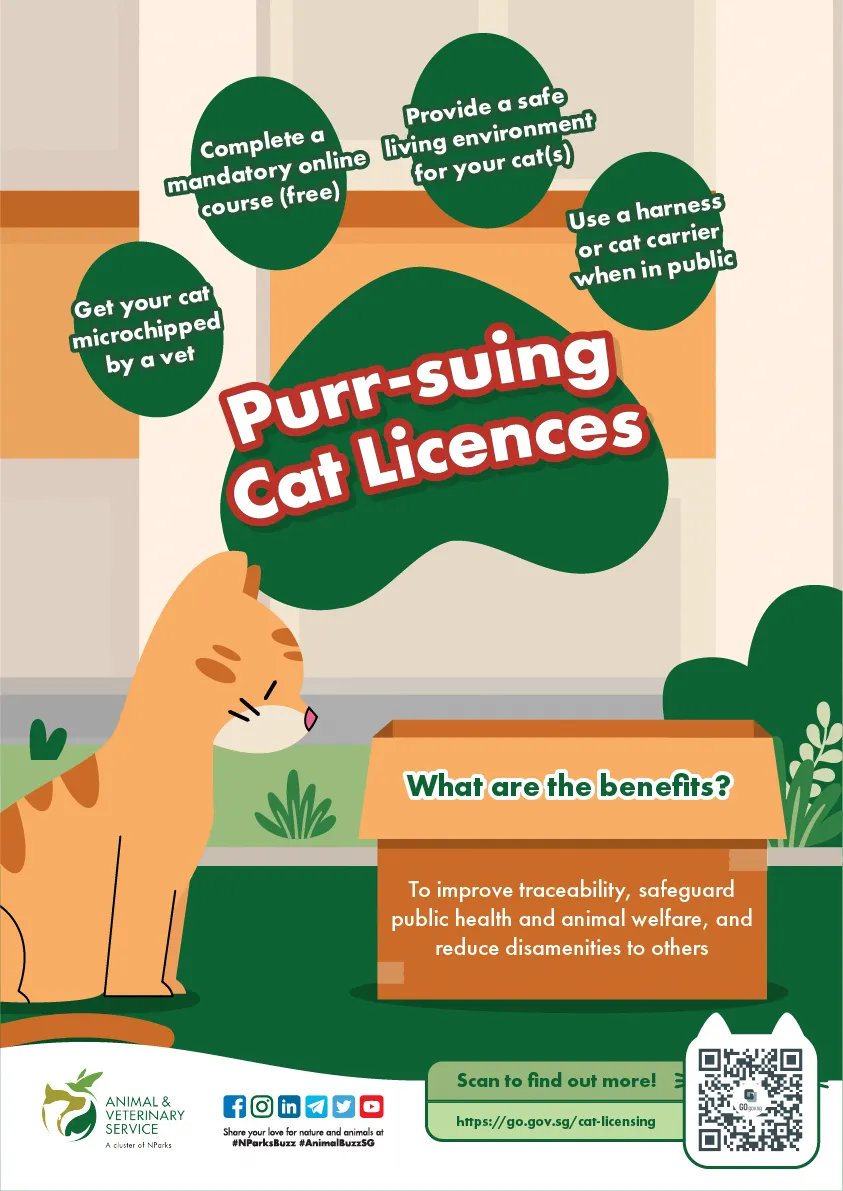
Cat will need to be implanted with a microchip
All first-time cat licence applicants will need to complete a one-time free online pet ownership course
Cat owners will need to ensure that their cats are kept in a safe environment and take reasonable steps to protect their cats from hazards, including but not limited to installing mesh, grilles, screens or other barriers to prevent the cats from roaming or falling from height.
When in public, pet owners will need to ensure that their cats are kept under physical control and not allowed to freely roam, such as by using a harness or placing their cat in a carrier.
During the two-year transition period, cat owners who are unable to produce a sterilisation certificate for their sterilised pet cat can declare in the licensing application form that their pet cat is sterilised.
Cat licence fees (from 1 September 2024 to 31 August 2026)
Licence fees for pet cats during the two-year transition period (From 1 September 2024 to 31 August 2026)
One-Year Licence | Two-Year Licence | Three-Year Licence | One-Time Licence | |
Sterilised Cats | NA | NA | NA | Free one-time licences with lifetime validity |
Unsterilised Cats | Free licences covering the transition period (Licences for unsterilised cats are issued on a renewal basis) | NA | NA | |
Dog and cat licence fees (from 1 September 2026 onwards)
Licence fees for cats/dogs not kept in a farm*
One-year licence | Two-year licence | Three-year licence | One-time licence** | |
Cats/Dogs below five months of age | S$15 per cat/dog | N.A. | N.A. | N.A. |
First three cats and/or dogs | Sterilised: S$15 per cat/dog Non-sterilised: S$90 per cat/dog | Sterilised: S$25 per cat/dog Non-sterilised: S$165 per cat/dog | S$230 per non-sterilised cat/dog | S$35 per sterilised cat/dog |
Fourth and subsequent cat/dog | S$180 per cat/dog OR A reduced licence fee of S$15 for the fourth cat/dog^ | S$325 per cat/dog OR A reduced licence fee of S$25 for the fourth cat/dog^ | S$460 per non-sterilised cat/dog | S$460 per sterilised cat/dog OR A reduced licence fee of S$35 for the fourth cat/dog^ |
*A 10% rebate is extended to licensees who make payment via GIRO, online, or via AXS. Prices quoted exclude the 10% rebate.
**You will be able to apply for a one-time licence for sterilised cats/dogs that is valid throughout the life of the cat/dog. Three-year licences for non-sterilised cats/dogs will automatically be changed to a one-time licence when you update the cat/dog's sterilisation status.
^Cat has to be sterilised and adopted from our animal welfare rehoming partner. Dog has to be a sterilised, obedience-trained local mixed breed adopted from our animal welfare rehoming partner.
Frequently asked questions
I have previously registered my cat on iFAST. Do I still need to license my cat?
Yes. Cat licences can only be applied via the Pet Animal Licensing System (PALS) at pals.avs.gov.sg.
My cat was adopted from an Animal Welfare Group. Do I still need to license my cat?
All pet cats, whether purchased or adopted, must be licensed. If your cat was adopted before 1 September 2024, please proceed to apply for a cat licence via the Pet Animal Licensing System (PALS) at pals.avs.gov.sg.
What will happen if I do not license my cats?
A two-year transition period will be introduced to allow pet owners to ease into the changes and meet the cat-keeping rules and licensing conditions. The transition period will be from 1 September 2024 to 31 August 2026. It will be an offence to keep unlicensed pet cat(s) from 1 September 2026 onwards.
I am a cat fosterer. Do I need to license my fostered cats?
Similar to pet owners, fosterers should license the cats they are fostering in their homes when cat licensing commences on 1 September. When the cat is adopted or rehomed, the fosterer can initiate the licence transfer to the new owner via the Pet Animal Licensing System (PALS) at pals.avs.gov.sg.
I am a community cat caregiver. Do I need to license my community cat?
No, only pet cats need to be licensed. Community cat caregivers are encouraged to register their community cats for traceability. This will help us reach out to you if we receive your cat in our shelter. For more information on how to register community cats with AVS, please visit this page.
Do I have to pay for licensing fees? If yes, how much do I need to pay?
Between 1 September 2024 to 31 August 2026, all cat licences will be issued for free. One-time licences with lifetime validity will be issued for sterilised cats while licences covering the transition period will be issued for unsterilised cats. Licences for unsterilised cats will be chargeable upon renewal after the transition period.
Microchipping is required for a cat to be licensed. How much does it cost to microchip a cat?
The cost of microchipping a cat can vary across different veterinary clinics. Cat owners should check directly with the veterinary clinic first before arranging for their cat to be microchipped.
What is the difference in costs between licensing sterilised and unsterilised cats after the transition period?
We strongly encourage cat owners to sterilise their cats before licensing them. Sterilising their cats will not only prevent unwanted breeding but offers health and behavioural benefits to the cats as well – sterilised cats will have a reduced risk of certain cancers, and are less likely to roam and caterwaul. It will also cost more to license unsterilised cats after the transition period. The following table illustrates the differences in costs of licensing.
Costs of licensing after the transition period (i.e., from 1 September 2026 onwards)
Number of cats that the owner has | If owner has sterilised all of his/her cats | If owner has not sterilised all of his/her cats |
1 | S$35 per sterilised cat for a one-time licence Total: S$35 | S$230 per unsterilised cat for a three-year licence Total: S$230 (Owner must renew the licence after three years) |
2 | S$35 per sterilised cat for a one-time licence Total: S$70 | S$230 per unsterilised cat for a three-year licence Total: S$460 (Owner must renew the licences after three years) |
3 | $35 per sterilised cat for a one-time licence Total: S$105 | S$230 per unsterilised cat for a three-year licence Total: S$690 (Owner must renew the licences after three years) |
4 | For first three cats: S$35 per sterilised cat for a one-time licence For fourth cat: S$460 per sterilised cat for a one-time licence Total: S$565 | For first three cats: S$230 per unsterilised cat for a three-year licence For fourth cat: S$460 per unsterilised cat for a three-year licence Total: S$1,150 (Owner must renew the licences after three years) |
5 | For first three cats: S$35 per sterilised cat for a one-time licence For fourth and fifth cats: S$460 per sterilised cat for a one-time licence Total: S$1,025 | For first three cats: S$230 per unsterilised cat for a three-year licence For fourth and fifth cats: S$460 per unsterilised cat for a three-year licence Total: S$1,610 (Owner must renew the licences after three years) |
Is it mandatory to sterilise my cats?
While sterilisation is not mandatory, we strongly encourage cat owners to sterilise their cats before licensing them. Sterilisation can bring about health benefits such as a reduced risk of certain cancers. It can also help to reduce sexually motivated behaviours such as caterwauling in cats. We strongly encourage cat owners to sterilise their cats as early as possible.
.png)
.png)