Dog training
Obedience and behaviour modification training for dogs
Last updated 2 March 2026
On this page
Dog Socialisation, Training and Behaviour Modification
Whether you're teaching your dog basic skills, socialising your puppy, or addressing behaviour problems, understanding how dogs learn and what makes training effective is essential. This section covers the fundamentals of dog training, the importance of early socialisation, guidance on obedience training and behaviour modification, and how to find qualified professional help when you need it. By using science-based, humane methods, you can build a strong relationship with your dog whilst keeping them safe and happy.
Dog Socialisation
Socialisation is the process of exposing your dog to different people, animals, environments, sounds, and experiences in a positive way so they learn to feel comfortable and confident in various situations. Proper socialisation can help reduce the risk of developing behavioural issues like fear, anxiety, and aggression later in life.
The critical socialisation period
Puppies have a critical socialisation window between approximately 3 and 14-16 weeks of age. During this period, puppies are most receptive to new experiences and form lasting impressions about the world. It is important that puppies are well-socialized during this time. Positive experiences during this time help shape a confident, well-adjusted adult dog.
However, this doesn't mean socialisation ends after 16 weeks — it is a lifelong process, though the early weeks are particularly important.
How to socialise your puppy
Expose your puppy to a wide variety of experiences in a positive, controlled manner:
Different types of people (children, elderly people, people wearing hats, uniforms, using mobility aids)
Various environments (busy streets, quiet parks, different floor surfaces and textures, car rides)
Different sounds (traffic, household appliances, fireworks recordings played quietly)
Other vaccinated, friendly dogs and puppies in safe settings
Handling and grooming procedures
Being alone for short periods
The key is quality over quantity. Each experience should be positive and not overwhelming. Watch your puppy's body language—if they seem scared or stressed, create more distance or end the session. Never force interactions. Let your puppy approach new things at their own pace, rewarding brave behaviour with treats and praise. Poorly managed socialisation that overwhelms your puppy can end up achieving the opposite effect, and making your puppy more fearful in the future.
Balance socialisation with your puppy's vaccination schedule. Whilst the critical period occurs before vaccinations are complete, you can still socialise safely by carrying your puppy in busy areas, inviting vaccinated dogs to your home, and attending puppy socialisation classes run by qualified trainers who maintain hygiene standards.
Socialising adult dogs
Adult dogs who missed early socialisation or have had negative experiences can still learn to be more comfortable with new situations, though it may take more time and patience. Go slowly, use high-value treats, and never force your dog into situations that frighten them. Consider working with a qualified animal behaviourist if your adult dog shows fear or aggression.
What socialisation is not
Socialisation doesn't mean your dog must interact with every person or dog they meet. It means they can remain calm and confident when encountering new things. Some dogs are naturally more reserved, and that's perfectly acceptable. The goal is a dog who can cope with everyday life without fear or stress, not necessarily one who wants to greet everyone.
Understanding Dog Training
How dogs learn
Dogs learn through association and consequences — they repeat behaviours that result in positive outcomes and avoid behaviours that result in negative outcomes. Modern dog training is based on scientific principles, particularly rewarding behaviours you want to see more of.
Rewards-based training
Modern, science-based dog training uses positive reinforcement — rewarding behaviours you want to see more of. When your dog does something desirable, you immediately reward them with treats, praise, or play, making the behaviour more likely to happen again.
This approach is supported by decades of scientific research and recommended by veterinary and animal behaviour organisations worldwide because it is effective, builds trust, makes training enjoyable, and works safely for all dogs.
For more information, please refer to our Guidelines for Dog Training and Behaviour Rehabilitation [PDF, 498KB].
The Least Intrusive, Minimally Aversive (LIMA) approach
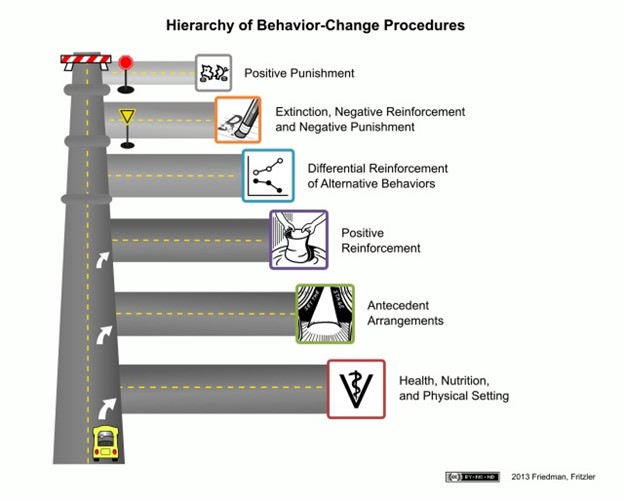
The LIMA approach and Humane Hierarchy guide trainers and owners to use the least intrusive and minimally aversive methods effective for addressing behaviour. This means starting with the gentlest, least aversive methods first.
The Humane Hierarchy prioritises interventions in this order:
Addressing health, nutritional, and physical factors first
Changing the environment to remove triggers
Using positive reinforcement to teach desired behaviours
Teaching alternative behaviours and removing reinforcement for problem behaviours
Only as a last resort, and with professional guidance, considering more intrusive methods
The risks of aversive training devices and techniques
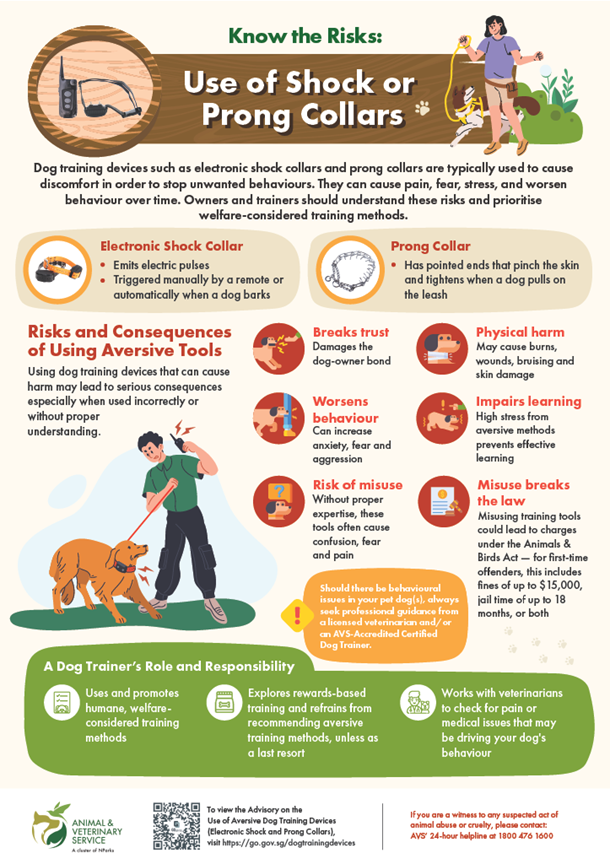
Aversive training uses unpleasant or painful methods to discourage unwanted behaviours. These methods carry significant risks that are well-documented in scientific research.
Devices and techniques to avoid:
Electronic shock collars (also called e-collars or electronic collars)
Prong collars
Physical corrections such as beating, kicking, choking, or forcefully lifting or suspending the dog above ground
Alpha rolls or scruff shakes
Any technique that causes excessive pain, fear, anxiety, or distress
For more information, please refer to the Advisory on the Use of Aversive Dog Training Devices (Electronic Shock and Prong Collars).
Basic Obedience Training
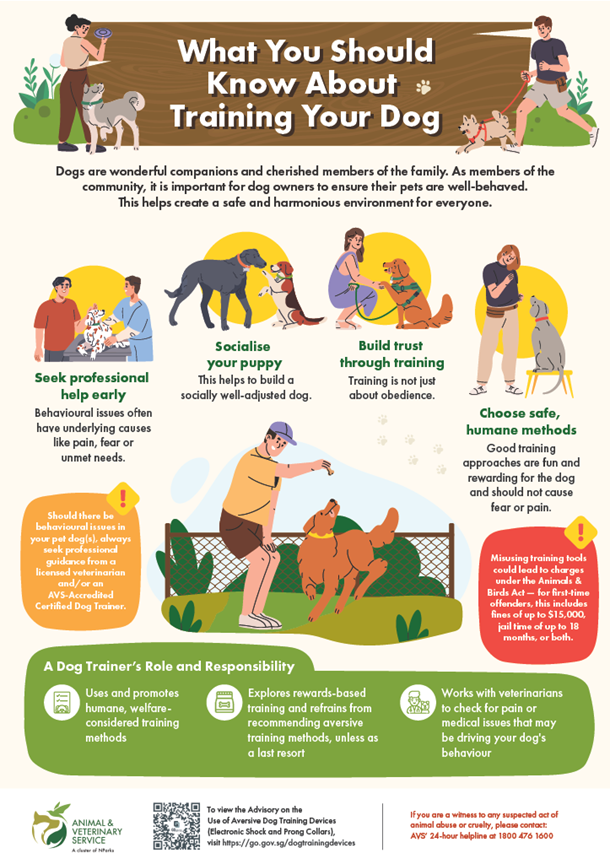
Basic Obedience Training equips dogs with the foundational skills and behaviours necessary to navigate daily interactions at home and in public spaces. Upon completion of basic obedience training, dogs are expected to be able to demonstrate basic cues such as sit, stay and come reliably.
While not mandatory for all dogs, it is highly encouraged for puppies to attend Basic Obedience Training to build a solid foundation during their early developmental stages.
The following types of dogs are required to undergo basic obedience training by an AVS-Accredited Certified Dog Trainer (ACDT):
Specified Dog breeds listed in the First Schedule of the Animals and Birds (Licensing and Control of Cats and Dogs) Rules 2024
Any dog assessed by AVS to be aggressive and/or potentially dangerous
Any dog adopted under Project ADORE (Obedience training for these dogs can also be carried out by ADORE dog trainers)
A copy of the course completion certificate must be submitted online via PALS, within 10 weeks of dog licence application, within 10 weeks from the arrival of the dog in Singapore, or within 10 weeks from the release of the dog from quarantine, whichever is later.
Behaviour Modification
What is behaviour modification?
Behaviour modification addresses problem behaviours that stem from fear, anxiety, frustration, or other emotional responses. Unlike obedience training, which teaches new skills, behaviour modification changes how a dog feels about specific triggers or situations, which in turn changes their behaviour.
Common issues requiring behaviour modification include:
· Fearfulness or anxiety (including separation anxiety)
· Aggression towards people or other dogs
· Excessive barking, destructive behaviour, or other stress-related problems
· Phobias (such as fear of loud noises, veterinary visits, or specific objects)
· Compulsive behaviours
How behaviour modification differs from training
Whilst obedience training teaches "what to do," behaviour modification addresses "why the dog is doing it" and changes the underlying emotional state. For example, teaching a fearful dog to sit on command doesn't address their fear. Behaviour modification would work on helping the dog feel less afraid in the first place.
Behaviour modification typically involves:
· Identifying triggers and understanding the dog's emotional state
· Systematic desensitisation (gradual exposure to triggers at levels the dog can handle)
· Counter-conditioning (changing the dog's emotional response by pairing triggers with positive experiences)
· Management strategies to prevent rehearsal of problem behaviours
· Addressing underlying needs (exercise, enrichment, rest)
Seeking help for behaviour issues
Behaviour problems rarely improve on their own and often worsen over time. Early intervention leads to better outcomes. If you're concerned about your dog's behaviour, seek professional help promptly. Consult a qualified professional if your dog shows:
· Aggression (growling, snapping, biting) towards people or other animals
· Severe fear or anxiety that affects their quality of life
· Separation anxiety (destructive behaviour, excessive vocalisation, or toileting when left alone)
· Compulsive behaviours (excessive licking, tail chasing, shadow chasing)
· Any behaviour that concerns you or impacts your household
Working with your veterinarian
Before addressing behaviour problems, consult your vet to rule out medical issues. Pain, illness, cognitive decline, and other health problems can often cause or contribute to behaviour changes. In these cases, addressing the medical issue itself can sometimes resolve the behaviour problem entirely.
Your vet can also refer you to appropriate behaviour professionals.
Choosing the right professional
Different professions have different expertise:
Dog Trainers teach obedience skills and basic manners. Qualified trainers using positive reinforcement methods can help with puppy training, basic obedience, and minor behavioural issues. However, serious behaviour problems require a behaviourist rather than a trainer. (Refer to our list of AVS-accredited trainers here)
Animal Behaviourists (or Behaviour Consultants) hold advanced qualifications in animal behaviour and work with behaviour modification. They're appropriate for fear, anxiety, aggression, and other emotional or behavioural problems.
Veterinary Behaviourists are veterinarians with additional specialised training in animal behaviour. They can diagnose behavioural disorders, rule out medical causes, and prescribe medication if needed. Seek a veterinary behaviourist for serious aggression, severe anxiety, or complex cases.
AVS-Accredited Certified Dog Trainer (ACDT) Scheme
The AVS-Accredited Certified Dog Trainer (ACDT) Scheme was launched on 10 December 2022 as a benchmark for competency in dog training to better manage dog aggression and other disamenities in an effective and humane way.
Under this scheme, dog trainers will need to obtain certification from any of the following independent animal behaviour and training organisations:
International Association of Animal Behavior Consultants (IAABC)
The Certification Council for Professional Dog Trainers (CCPDT)
This ensures that accredited trainers possess a basic understanding of science-based training methods, dog welfare and behaviour, are committed to ethical training approaches, and meet international standards of competency.
To find out more about the scheme, please click here.
For the full list of ACDT dog trainers, please refer to List of AVS-Accredited Certified Dog Trainers.